I thought that this was a spoof article at first, but apparently there's a tiny bit of Belgium inside an enclave of Holland that lies within a parcel of Belgium that's within the borders of Holland. (I think).
Hat tip to Red Rose Ramblings
Saturday, June 24, 2006


Posing the 100 Year Question: The Mathematical Answer

It's possible to argue, mathematically, that there is a 95% chance of mankind's extinction within 9120 years. This calculation is derived from the Carter Prediction.
I first came across the "Carter Prediction" in Stephen's Baxter's SF novel "Manifold: Time". It's a real proposition by a real eminent physicist, Brandon Carter.
Wikipedia calls it the Doomsday Argument, and I recommend you to read their article on this.
So what is this prediction? It's about how many humans will ever be born. Suppose you are shown a magic records office which contains a special birth certificate for every human that will ever be born, either in the past, the present or the future. The certificates are all numbered, starting at 1. There's been about 40 billion people born so far. If we die out in the next century, the total that will ever be born is about 46 billion. However, if we go on to exist as a species for a million years, the total number could be 50000 billion or more.
Suppose you ask for one of the birth certificates, completely at random. Suppose the certificate you are given is number 41 billion. - that is - it belongs to somebody alive now. So what's more likely - that there are 46 billion certificates in there- or 50000 billion or more? It's much more likely that there are only 46 billion or so.
Now, let's think about people instead of birth certificates . You are about the 41st billion person born. If mankind was going to last one million years, it's amazingly unlikely , isn't it, that you were one of the first 0.008 percent to be born.
This argument, to say the least, is disputed. I don't believe it myself - because if the "first" human had considered it, he or she would have deduced that the total number of humans to be born would be about 5, and that the species would die out in a generation.
However, despite attempts to shoot it down , the Carter Prediction still has it's supporters. Maybe the mathematical answer to the 100 year questiion is "Yes, humanity will survive, but statistically the odd are against us lasting much longer".
Ah well, I'll be getting to the politics side of this soon...
Monday, June 19, 2006

Sunday, June 18, 2006
Best Political Interview of The Year?
It's with Congressman Lynn A. Westmoreland
Colbert: You have not introduced a single piece of legislation since you entered Congress.
Westmoreland: That's correct.
Colbert: This has been called a do nothing Congress. Is it safe to say you're the do nothingest?
Westmoreland: I, I, ..Well there's one other do nothiner. I don't know who that is, but they're a Democrat.
Crooks and Liars has the video (WMP)
(Thanks to Political Wire )
Colbert: You have not introduced a single piece of legislation since you entered Congress.
Westmoreland: That's correct.
Colbert: This has been called a do nothing Congress. Is it safe to say you're the do nothingest?
Westmoreland: I, I, ..Well there's one other do nothiner. I don't know who that is, but they're a Democrat.
Crooks and Liars has the video (WMP)
(Thanks to Political Wire )
Tuesday, June 13, 2006
Posing the 100 Year Question: "The Ignore it" Answer
As my former group leader Trevor commented on my previous post "Muddling along is one thing, ignoring the problem is another altogether ". And he's right, perhaps it's the same sort of difference between Britain improvising survival from 1939 to 1945, and ignoring Hitler completely.
For somebody else's slant on those who ignore environmental problems, read Pharyngula here
It begins:
It's a peculiar pathology that thinks environmentalism is an evil plot, that planning is communism/socialism, and that Jesus was a good capitalist. It is particularly irksome to try and deal with people who are so far gone that they deny science warning them of environmental dangers and impending problems.
How irksome? Imagine that a scientist and one of these deranged libertarian right-wing anti-environmentalist science deniers go out for a drive one day...
For somebody else's slant on those who ignore environmental problems, read Pharyngula here
It begins:
It's a peculiar pathology that thinks environmentalism is an evil plot, that planning is communism/socialism, and that Jesus was a good capitalist. It is particularly irksome to try and deal with people who are so far gone that they deny science warning them of environmental dangers and impending problems.
How irksome? Imagine that a scientist and one of these deranged libertarian right-wing anti-environmentalist science deniers go out for a drive one day...
Sunday, June 11, 2006
Posing the 100 Year Question: The "Muddle Through" Answer

When I was a lad Isaac Asimov was my favourite science fiction writer - he wrote great novels such as "The Gods Themselves" and "The Naked Sun". I used to read his non-fiction books as well, borrowing them from Rayleigh library. Asimov was so famous that he could sell his articles to the top-paying magazines, such as Penthouse!
Now, he had an article published in the January 1971 edition of Penthouse entitled "The End". It wasn't a very sexy piece, simply a warning that civilisation could not survive the coming overpopulation crisis. (I hasten to add I only read it when it was published in book form in 1973!) He wrote a follow-up article, entitled "Can Man Survive the Year 2000?" Well, we've got past the year 2000 and we are still doing pretty well. Did my boyhood hero get it all wrong?
Similarly, I remember reading the Population Bomb by John Ehrlich. In particular I remember the scenario of nuclear war in 1984 caused by a lack of resources where ultimately the most advanced species surviving is the cockroach. It didn't happen.
Now, it's easy to mock people when you have the benefit of hindsight, but there have been scientifically trained forecasters of doom for quite a while and they haven't been correct yet. There's no doubt that overpopulation and a lack of resources are going to continue to be a problem, but maybe technological ingenuity will find the answers. For example, a recent edition of New Scientist discussed the possibility of global warming increasing the number of earthquakes. But the same edition also reported on the possibility of greatly improved solar power. Maybe mankind can just muddle through, with new technological advances keeping pace with our environmental problems. I know where I would rather be - facing global warming in 2006 rather than Hitler in 1939 or the Cold War in 1962.
And just to show how easy it is to forecast climatic change, here's an extract from a 1973 speech by my hero (and he still is my hero):
Well, here we are. We have just come through a thirty year period of mankind's maximum prosperity, on the whole. We've done very well since World War Two. We have...the world as a whole has eaten better, has lived better, has had a higher standard of living than it has ever had before. Now, you might tell me that through this entire thirty years there have been millions...hundreds of millions of people always hungry, always starving, with very little, and I'll say yes; it's been rotten. My point is that before now, it's always been rotten-ER. And we haven't really appreciated how temporary this is.
For one thing, we've had ample supplies of food, and part of the reason for that was that we've had an extremely good spell of weather for the last thirty years. In fact, there are some people who say that this last thirty years was the best thirty year spell of weather that we have had in the last thousand years. Now you may remember cold spells, and floods, and droughts, and all the rest of this stuff. But there has been less of it the world over than usual. In addition, just as we've had this good weather, we've also been applying energy at a far greater rate than ever before to farm machinery, to irrigation machinery. In addition, we've been using insecticides and pesticides of various sorts, to sort of clobber those little beasties and those weeds who think they're going to get some of our food. And in addition to that we've also developed new strains of grain, so-called "green revolution", that grow a lot of protein very fast. And what with all these things put together, our food supply has been going up.
But now, look what happens.
The very thing that makes it possible for us to use more and more energy is our industrial technologized world. And another thing that our industry produces is dust. And the air is dustier now than its ever been before in human history. Except perhaps very temporarily after a large volcanic eruption.
This means that the Earth's albedo, the percentage of light from the sun that it reflects back into space before it hits the ground, has been going up slightly because dusty air reflects more light than clear air does. And...well, not very much more, but enough. It has been making the temperature of the Earth drop since 1940. It's been going down steadily. Again, not very much. You're probably not aware that the summers are cold, or that the winters are extraordinarily icy, they're not. The drop in temperature may be one degree. But it's enough to cut down on the growing season in the northern climates. It makes the weather a little bit worse. It sends the storm tracts further south, so that the Sahara Desert creeps southward, so that the monsoon rains in India fail a little bit. Just enough so that the harvests aren't as good as they used to be, and the Earth's reserve supply of food sinks to it's lowest in recent history.
And just as this is happening...and it's going to continue happening because the air isn't going to get un-dusty unless we stop our industrial activity. And if we stop our industrial activity, that's going to be because we've suffered some complete disaster.
So, the weather isn't going to turn better. The air is going to stay dusty, and it's going to continue getting a little colder. And at the same time, it's getting hard to get energy. Energy is much more expensive than it used to be; oil prices are up. And that means that fertilizer is more expensive than it used to be. And it turns out that the green revolution depends on strains of grain that require...yes, they do what they're supposed to do...but they require a lot of irrigation; a lot of water, and a lot of fertilizer. And the fertilizer isn't there. And the irrigation machinery is hard to run now with expensive oil. And, of course, the pesticides are produced in high-energy chemical factories; their price goes up. Everything is combining to cut down on the food supply. And to arrange it so that in years to come, we may have trouble keeping our present level of food, let alone increasing it.
.....
There are always people who think that all we have to do, after all is abandoned, all this foolish technology that we've made ourselves slave to, and go back like our ancestors and live close to the soil with the good things of nature. That would be great if we could do it. If we could go back to the way it was before World War II, technologically, we could support all the people that lived on Earth before World War II. The catch is that in these last thirty years one billion and a half people have been added to the population of the Earth. And we have been feeding them largely because of all these things that we have done in these last thirty years, the good weather, the fertilizers, and the pesticides, and the irrigation, and the green revolution, and all the rest of it. If we abandon that, we also have to abandon a billion and a half people; and there are going to be very few volunteers for the job.
Thursday, June 01, 2006
Tuesday, May 30, 2006
Posing the 100 year Question: The Threads Answer
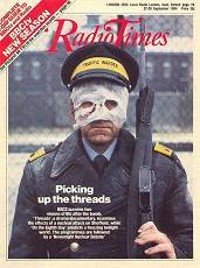
The most obvious way for humanity to be wiped out is by nuclear war. And it's nearly happened several times.
Somehow I can't worry too much about Osama bin Laden when I know that Leonid Brezhnev and Richard Nixon could have caused infinitely more destruction in 10 minutes than bin Laden could dream of doing in a year.
At the end of the Cold War days, back in 1984, I can remember the BBC broadcast of Threads, perhaps the most despairing, the bleakest account of Nuclear War ever seen on the TV or cinema screen. I had a nightmare that night of an awful wind blowing across the landscape. If you haven't seen it, or heard of it, here is a review from the IMdb website:
Absolutely terrifying, utterly disturbing. 9 September 2005
Having just purchased this on DVD I was eager to watch it after waiting years to see it after it was unofficially banned from ever being shown on the BBC again. I was four when it was first shown and my parents switched it off, too frightened to watch it themselves never mind let me see it.
I have to say it is absolutely terrifying and utterly terrifying in the extreme. This could have actually happened! I was impressed by the way the film conveyed what it would be like if thousands of megatons of atomic bomb was dropped on the U.K. Normal life comes to an abrupt stop. One minute people are shopping in their local supermarket, going to the pub and wallpapering their new flat and suddenly they are plunged into Hell. Civilisation is blown back into the stone age.
The most scary part was the way the authorities were shown unable to cope with the scale of the attack (perhaps why the BBC never aired it again). We always think that it could never be that bad because someone would come to our rescue, someone would maintain control. But no, the bombs / missiles keep raining down and down prompting one traumatised emergency committee member to scream, "not another one!" They just did not expect so devastation and are completely helpless. Later soldiers shoot people for food, people wish for death and the emergency committee, those meant to be running things, die in the supposed protective bunker, trapped by rubble.
Ten years later, nothing is back to normal. What young people there are behave like wild animals, raping and fighting and speaking in a bizarre caveman manner.
Since the Cold War ended people have stopped being frightened of nuclear weapons. Everybody in every country should watch this film and realise that if there ever was a nuclear war, still possible with growing tensions between a superpower and its rivals, those left alive would wish they had been caught in the blasts and killed outright.
Sometimes we need to be reminded that if the politicians get things wrong, civilisation could be effectively destroyed in an afternoon.
Monday, May 29, 2006
Posing the 100 Year Question: The Underkill Answer

One of Earth's possible futures is what PZ Myers calls "Wallowing in Poverty and War and Desperation". It's what happens if we run out of resources.
James White's 1979 novel, "Underkill" describes in detail what sort of life we might have in such a grim world. It's long out of print but a few copies are available secondhand from the likes of Amazon.
White's books are normally optimistic, with compassionate, determined individuals solving problems and crossing the stars. But "Underkill" is set in an Earth critically short of energy. Society is authoritarian, violent and stratified, food and resources are low , and terrorists are causing more and more casualties.
White's characters - husband-and-wife doctors Malcolm and Ann, and police inspector Reynolds - are still compassionate and determined, but they are fighting a losing cause.
"Hello Doctor Malcolm" , said the boy smiling "I'm sorry , I was dreaming about rats, and one of them bit my arm. Is Nurse mad at me?"Tommy later has a nightmare about school:
"Of course not", said Malcolm "But she would like you a lot better if you were to ask her for something to eat and drink, Tommy. I know you don't feel hungry, but that is because your stomach is very small and not used to much food. But you need food to help your broken arm and legs mend. Do you understand that? And it's nice , clean , food, like the Uppers eat".
"You are a stupid, sneaking, snivelling wretched boy said the Senior Educator in his quiet, angry voice. You are nine years old and you still act as if you had just come out of the nursery"So much of this book is horribly believable. Especially a confrontation between another doctor and a group of terrorists:
"Nobody likes walking the wheel" he went on "But your wheel is one designed for a child half your age, and little more than a toy. Yet you cry and faint, and don't make enough power to light the room much less help run the machines. All you want to do is the tidying and cleaning jobs where you can work by yourself, because you say your classmates are a bit rough on you. Or you hang about when the older boys are at advanced classes. But remember boy, the knowledge of mathematics and reading and writing is not a gift. It is a privilege, which must be earned by hard work. Perhaps a few of our boys will eventually become technicians or planners or medics. But we are in the business of producing the future power walkers, food processors and artisans, the kind of responsible citizens which enable this city to survive"
"You destroy from within by using the structure of society against itself. When fair-minded people bring in liberal laws, you turn them to your own advantage and discredit the people who are trying to keep the laws. The death penalty is bad, barbarous you say, but you yourselves don't hesitate to use it against people who have done you no wrong"There is more to this story than pure doom. Reynolds suspects there are aliens somewhere on Earth influencing events :
"It worries me , Doctor" said Reynolds. "Gadgets like your scanner turn up in all sorts of places. But one finds that pre-Powerdown technology was never that good".And indeed there are aliens, whose appearance and methods are just about unique, even in science fiction.
"Underkill" is worth reading simply as a Dreadful Warning, but it is much more than that, and the ending of the book left me stunned and perplexed. It greatly deserves to be reprinted, and would actually make a good TV drama.
Posing the 100 Year Question:
Peter McGrath very usefully mentioned this posting by PZ Myers which asked the question "Will the 'human' race be around in 100 years?
Myers speculates on three possible outcomes:
Here's a tip: spend some time reading through the comments to Myers' post. Some very good thought-provoking stuff here , with links to some other sites. After all , if you are going to have a baby in the next few years, the end of the century could be your baby's old age.
In my next post I want to write about how option 1 might look in practice - the "Underkill" answer.
Myers speculates on three possible outcomes:
1. We keep going as we have been. The population is double what it is now or more, and resources are scarcer. We continue to tear at the planet, squabbling over what's left, and we're wallowing in poverty and war and desperation. That can't last, of course: sometime beyond that century mark, or before, we hit scenario 2.
2. There is a major resource crash. The oceans are exhausted, climate change wrecks agriculture, plagues rip through a bloated population, and there is a massive die-off of humanity. Populations drop precipitously, leaving only scattered enclaves. Civilization as we know it ends. Humanity continues, but in a barbarous state.
3. The optimistic scenario: some cultures practice restraint, using technology to control population growth and develop sustainable food and energy resources. They work to bring about scientific and technological advances that improve their chances for survival and progress. Unfortunately, the whole world won't do that: the gap between the haves and have nots widens. On one side, population reductions by choice and with little disruption; on the other, population reductions by starvation and suppression and war.
Here's a tip: spend some time reading through the comments to Myers' post. Some very good thought-provoking stuff here , with links to some other sites. After all , if you are going to have a baby in the next few years, the end of the century could be your baby's old age.
In my next post I want to write about how option 1 might look in practice - the "Underkill" answer.
Now this isn't what I expected...
But some of the questions shouldn't really be restricted to just two possible answers....
Found via Rambling With Roger
as was this ...
| Your Political Profile: |
| Overall: 45% Conservative, 55% Liberal |
| Social Issues: 25% Conservative, 75% Liberal |
| Personal Responsibility: 50% Conservative, 50% Liberal |
| Fiscal Issues: 50% Conservative, 50% Liberal |
| Ethics: 25% Conservative, 75% Liberal |
| Defense and Crime: 75% Conservative, 25% Liberal |
Found via Rambling With Roger
as was this ...
| You Are 40% Open Minded |
 You aren't exactly open minded, but you have been known to occasionally change your mind. You're tolerant enough to get along with others who are very different... But you may be quietly judgmental of things or people you think are wrong. You take your own values pretty seriously, and it would take a lot to change them. |
Saturday, May 27, 2006
Asda
In the past year my biggest local matter to deal with has been a planning application in the ward I represent for a neighbourhood centre. Nothing wrong with that , you might think. There were even conditions on the outline planning consent for 'a range of uses valuable to the local community' and that the traffic numbers would not be 'demonstrably detrimental to the convenience or safety of highways users'
But the application that came in last year was from Asda - for a supermarket, plus some smaller shops, flats and a only a couple of units that could be for community uses.
It was a big local issue. Officers recommended approval, but the two Lib Dem ward members (Ron Oatham and myself) moved refusal and won by a fairly narrow margin. Asda have gone to an appeal on their first application and submitted a second one to the council. This keeps the store at the same size, but gets rid of the flats and replaces them with more units for community use.
Local opinion is split roughly 70-30 against Asda (although in terms of letters to the council it's more like 40- 1). The local chambers of trade, and our local Tory MP , Mark Francois, have been very much against. Local residents were mostly concerned about traffic and the effect of a 23-million-pound-turnover edge-of-town store on our existing shopping centres.
To cut a long story short, we moved refusal on the second application last Thursday and won 26-6. Ron got a round of applause and I got so many pats on the back that I can still feel the dents in my shoulder.
Will Asda continue with their appeal, or will they go for something smaller and more acceptable? We will see.
But if anyone out there has experience of seeing those nice chaps from Asda at a planning inquiry, I'd be glad to hear from you.
But the application that came in last year was from Asda - for a supermarket, plus some smaller shops, flats and a only a couple of units that could be for community uses.
It was a big local issue. Officers recommended approval, but the two Lib Dem ward members (Ron Oatham and myself) moved refusal and won by a fairly narrow margin. Asda have gone to an appeal on their first application and submitted a second one to the council. This keeps the store at the same size, but gets rid of the flats and replaces them with more units for community use.
Local opinion is split roughly 70-30 against Asda (although in terms of letters to the council it's more like 40- 1). The local chambers of trade, and our local Tory MP , Mark Francois, have been very much against. Local residents were mostly concerned about traffic and the effect of a 23-million-pound-turnover edge-of-town store on our existing shopping centres.
To cut a long story short, we moved refusal on the second application last Thursday and won 26-6. Ron got a round of applause and I got so many pats on the back that I can still feel the dents in my shoulder.
Will Asda continue with their appeal, or will they go for something smaller and more acceptable? We will see.
But if anyone out there has experience of seeing those nice chaps from Asda at a planning inquiry, I'd be glad to hear from you.
Sunday, May 21, 2006
Politician Removal Service
If I was an American I wouldn't be a Libertarian.
But I do think their new animation is quite effective...
(found via Hammer of Truth)
But I do think their new animation is quite effective...
(found via Hammer of Truth)
Sunday, May 14, 2006
The Missing Headline
According to the Guardian today:
So:
Labour DOWN 149
Tories UP 100-120
This therefore predicts that Labour will lose 29-49 seats to some other party than the Tories. But they don't say who.
But here's a clue in the Electoral Reform Society's website:
London seats on new boundaries
Sp perhaps the headline in the Guardian should read "Lib Dems on course for up to 111 seats - Ming will be the key player in the new Parliament."
Of course this is totally speculative, but in the light of some comments in the last few days, I thought it was a point worth making.
Labour could be heading for a wipe-out by David Cameron's Tories at the next general election, says the first detailed study of the local election results and their possible impact.
The analysis, compiled by the Electoral Reform Society and released to The Observer yesterday, predicts that Labour stands to lose 149 of its present 355 MPs, bringing its Commons strength down to 206 - 'even worse than in 1983'.
The Tories could add between 100 and 120 MPs to their current 198. This would probably give them more than 300 MPs, comfortably the largest party and 'with new seats created in boundary changes, on the verge of an overall majority'.
So:
Labour DOWN 149
Tories UP 100-120
This therefore predicts that Labour will lose 29-49 seats to some other party than the Tories. But they don't say who.
But here's a clue in the Electoral Reform Society's website:
London seats on new boundaries
Conservatives
2002 locals, 28 seats
2005 General Election, 19 seats
2006 locals, 38 seats
Labour
2002 locals, 37 seats
2005 General Election, 46 seats
2006 locals, 26 seats
Liberal Democrats
2002 locals, 7 seats
2005 General Election, 7 seats
2006 locals, 9 seats
Sp perhaps the headline in the Guardian should read "Lib Dems on course for up to 111 seats - Ming will be the key player in the new Parliament."
Of course this is totally speculative, but in the light of some comments in the last few days, I thought it was a point worth making.
Subscribe to:
Posts (Atom)